I would like to explore two vital principles from Swami Kriyananda’s tradition which can help us in cultivating attunement with Swami Kriyananda as a channel for Ananda Sangha and staying deeply in tune with the Master. I highly recommend reading the ‘Last Will and Testament’ he wrote before passing in 2013. In this Will, he covers a wide range of topics, but toward the conclusion, he invites us to reflect on his legacy with these words “My wish is that Ananda always remains true to these principles and remain faithful to the following twin ideals based on the example and teachings of Paramhansa Yogananda”.
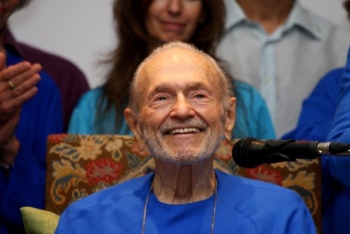 Swami repeatedly emphasized two core principles to ensure we stay true to our spiritual path. He reminds us, first, that “People are more important than things,” and secondly, “Yato Dharma Tato Jaya”—where there is adherence to righteousness, there is victory.
I was reminded of a time I was once with Swami Kriyananda and of what it meant to be in tune with him. He once told me: “try to understand what I am trying to do. And in the process the process of doing that, you’ll find yourself in tune with what I am trying to do; we’ll be in tune together”.
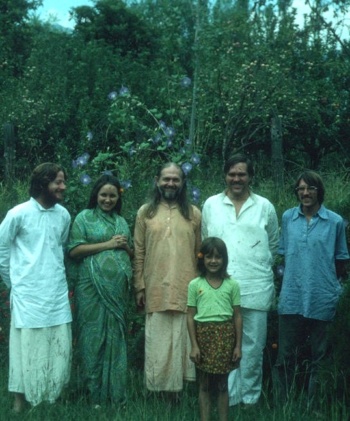 And, there was another time I was standing with him. At Swamiji’s home at Crystal Hermitage, where he lived, he has a dome and a deck that looks out over a canyon of the Yuba River far down below. One day, some others and I were with him on that deck looking out across the valley to something on the other side. I don’t remember exactly what it was. We were looking at a house there. Maybe there was some smoke, or a potential fire. Whatever it was, it caught our attention and Swami said, “Oh, look at that.” And he pointed using his finger to point across the canyon. And some of us said, “Oh, what? Swami, What?”. He said, “There, there, there, look. See?!” And I said, “I couldn’t make out exactly what he was pointing at.” And he says, “Come here. Come here. Stand right here.” and then he had me look down the line of his arm and his finger to where he was pointing. “You see that?” And I said, “Yes, yes! I see it.” And the interesting point that stuck with me, was in essence, he was saying, “Stand right here where I’m standing and look, and you’ll see.” And isn’t this what attunement is? It is learning to stand in the spot where the Master stands. Stand in the spot where Swami stood. Stand in the spot of another person so that we can see life through their eyes. And when we put ourselves in that spot, we see life as they see it.
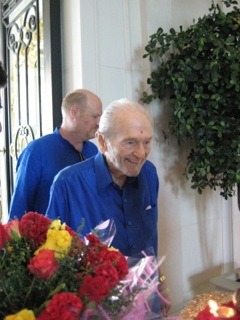
And isn’t that what pulls us in attunement? And when we apply it in more subtle contexts of what we are talking about, attunement to dharma. There is a story about two disciples whom Swami sent to establish a centre in another city. After a few months, the monks—Brahmachari Haridas and Brahmachari Vijay—returned. During a Satsang, Swami turned to Haridas and asked how the mission was progressing. Haridas replied, ‘It is going quite well, Swamiji, but we have learned. “Haridas told Swami, ‘We are both trying to do God’s will, but I’ve learned that God sometimes has two wills.’ In other words, he and Vijay were both sincerely seeking the Divine, yet that will being expressed differently through each of them, requiring them to work through the friction.
 This reminds me of a story Nayaswami Devi shared about a time she and Jyotish had a significant disagreement with another senior devotee. The other devotee felt strongly that Devi and Jyotish were headed in the wrong direction.” Because the other devotee felt so strongly, Devi and Jyotish began to doubt themselves. They wondered if they were in the wrong, so they went to Swami for guidance. ‘Swamiji,’ they asked, ‘are we doing the right thing?’ Swami paused. He didn’t offer a simple ‘yes’ or ‘no.’ Instead, he said, ‘Devi, you are doing the best you can for who you are. “After a brief silence, Swami added, ‘And so-and-so is doing the best she can for who she is.’ He paused again, likely with a smile, and concluded, “And I am doing the best I can for who I am.” Through this, he showed that all three were sincerely acting on the teachings as they understood them. It illustrates that Dharma can vary; its expression depends on the purity of one’s heart and the intention to follow the highest guidance possible. When it seems like a Master has given contradictory advice, it’s often because the truth was tailored to the individual—one instruction for one person, and another for someone else.” While truth is subtle and cannot always be spelled out in a simple checklist, there are universal principles we must all strive toward: harmony, good heartedness, and compassion. Swamiji’s response suggests that we should seek the highest path by setting aside our personal likes and dislikes.
When faced with two paths where one is significantly easier than the other, I have learned not to trust the easy road blindly. It isn’t necessarily wrong, but we should pause and ask: Why is it easier? Does that ease make it right? While the harder road isn’t automatically the correct one, Dharma often demands a sacrifice of our own convenience. This was put to the test during the devastating forest fire at Ananda Village in 1976. The fire was caused by faulty machinery owned by the Nevada County government, making them technically and legally responsible for the destruction of our community. The fire didn’t just affect us; it devastated the entire neighbourhood. At Ananda, we lost nearly 90% of our residential structures, leading to years of immense hardship as we struggled to find temporary housing and rebuild. Because the county was legally liable, a lawsuit was the obvious path. In fact, many of our neighbours joined together to sue and eventually won significant settlements. As the largest entity affected, we had the strongest case—but after deep consideration, Swamiji made our position clear: “No, we are not going to sue. It simply does not seem right thing to do”. While some might have debated the decision, the community largely agreed: this was a karmic event, and we refused to take our ‘bad karma’ out on our neighbours or the county. In the end, that fire was a purification. It burned away the old structures, but it also seemed to burn away negative karma, allowing us to start fresh. Our goal wasn’t to gain favour, but our refusal to sue transformed the local government’s suspicion into deep appreciation. That single ‘right’ decision shifted the entire energy between Ananda and the public officials. It proved that when you act out of sincerity rather than gain, the resulting goodwill is far more valuable than any financial settlement. It gained a lot of good karma and good will at the end.
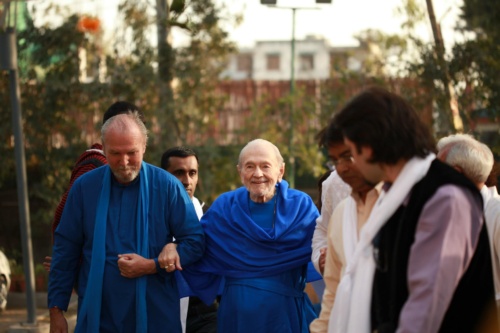 Years later, I faced a different kind of test. Ananda was enduring a wave of public negativity, with local newspapers publishing smears and accusations against our community. As the official liaison to the county government, my signature carried significant weight. Swamiji wrote a powerful, well-stated letter to correct these misstatements and asked several leaders to co-sign it. Everyone had signed except me. When he asked why I was hesitating, I had to be honest: ‘Swami, I cannot sign this. You weren’t there for these specific events, and the facts are incorrect. It attributes things to a person that are simply unfair. Swamiji’s letter had been based on hearsay—reports from others in the community that he had accepted as fact. When I told him the details were wrong, I could see a moment of frustration; the correction had stalled the momentum of his response. However, instead of pushing me to sign, he went to verify the facts with Jyotish. When Jyotish confirmed my account, saying, ‘Yes, he’s right; the letter isn’t accurate,’ Swamiji didn’t hesitate. He immediately tossed the draft aside.
The lesson that stayed with me forever was his absolute commitment to the truth—even when it was inconvenient, he prioritized the highest principle over being ‘right. In that moment, I had to gather my courage to tell Swamiji he was wrong. I was nervous, but I knew that Truth was the goal—a principle he had always championed. Looking back, I wonder why the others signed a letter they knew was inaccurate. Did they think they were being ‘in tune’ by simply agreeing? Swamiji was disappointed in that; he didn’t want blind compliance—he wanted a shared striving for Truth.